Could a Dakar Rally Defender Become Street Legal?
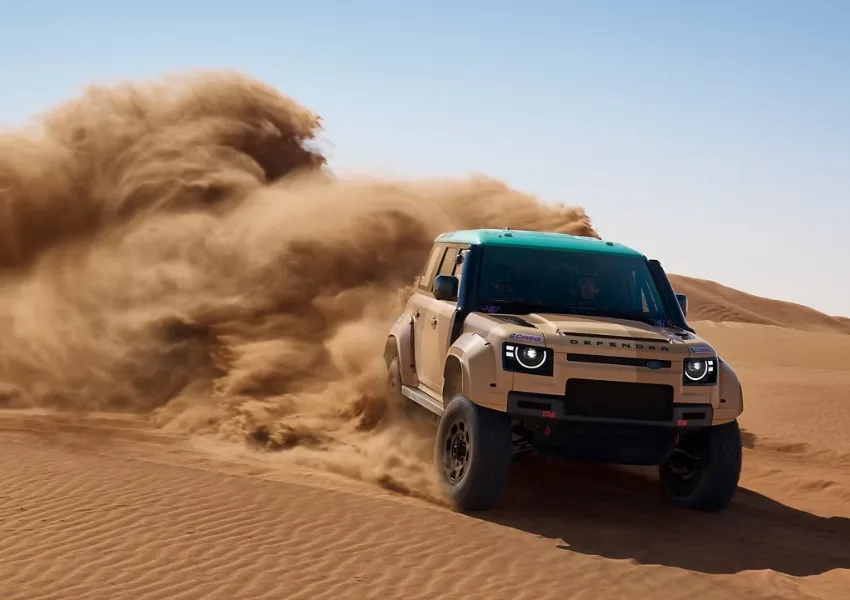

The Defender Dakar D7X-R
Image credit: landrover
Land Rover’s history at the Dakar Rally stretches back decades, but 2026 marks a turning point. For the first time, the modern Defender brand has entered the world’s toughest rally with a fully factory-backed effort. Even before the current Dakar has wrapped up, Defender is already asking a question that has caught the attention of enthusiasts worldwide: could its rally car inspire a road-legal version you could actually drive?
That vehicle is known internally as the Defender D7X-R, and the idea isn’t about decals or cosmetic upgrades. The ambition, according to Defender leadership, is to create something that stays as close as possible to the rally machine while still meeting road regulations. For you, that raises the intriguing possibility of owning a Defender shaped by Dakar-level engineering rather than marketing.
Exploring the Business and Legal Reality
Turning a Dakar racer into a street-legal SUV is not just an engineering challenge. Defender is currently studying regulations across multiple global markets to see where such a model could realistically be sold. Europe, with its stricter approval standards, presents hurdles. The US, however, appears more promising thanks to relatively flexible homologation rules.
The bigger question is whether the project makes financial sense. Jaguar Land Rover has faced well-documented pressures in recent years, and a low-volume halo vehicle must justify its development costs. Defender believes there is precedent. The Defender OCTA has already shown that buyers are willing to pay a premium for extreme performance and off-road capability. A rally-derived Defender would go even further, prioritising off-road performance almost entirely.
If successful, it could sit at the very top of the Defender range, reinforcing the brand’s motorsport credentials just as Dakar results begin to build momentum.
How Close the Rally Car Is to Production Roots
One reason the idea feels realistic is how closely the D7X-R already mirrors a production Defender. The rally car is based on the Defender 110 and shares its aluminium D7x architecture with both the standard model and the OCTA. In fact, early test vehicles were little more than modified OCTAs fitted with larger tyres.
Dakar’s T2 regulations require the use of a production-based chassis, engine, and drivetrain casings. While Defender has strengthened internal components such as differentials and axles, the fundamental structure remains recognisably road-car based. For you, that means a street-legal version would not require a ground-up redesign.
Suspension
The most significant changes lie underneath. To survive Dakar stages, Defender replaced the OCTA’s air suspension with a custom coil-spring setup and passive dampers. This choice was driven by durability, simplicity, and ease of repair in extreme conditions.
A road-legal rally Defender would likely retain much of this architecture but with revised tuning. Spring rates, damper calibration, and anti-roll bars would need to balance stability, comfort, and legal requirements. The race vehicle also uses dual rear dampers to manage the weight of its massive fuel load and onboard equipment, a setup that would be unnecessary on a road-going version.
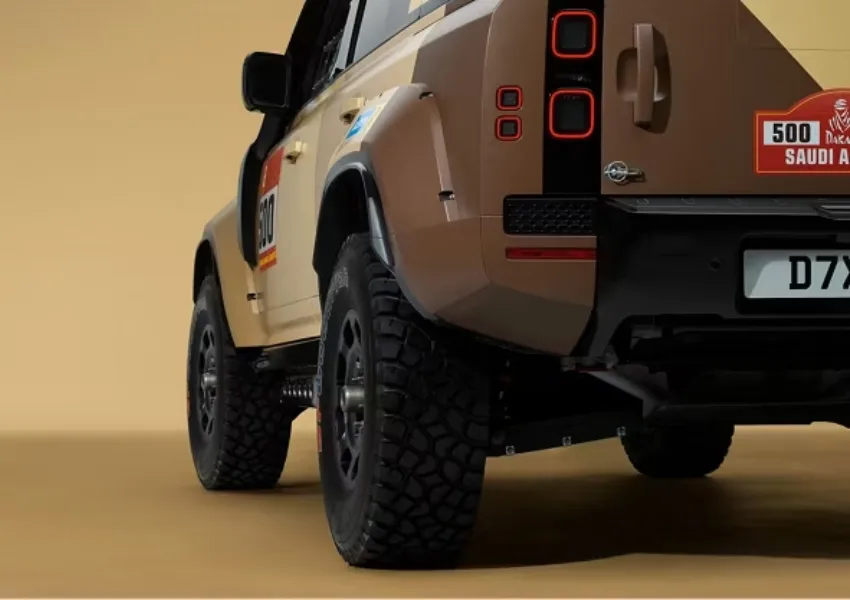
Derived from Defender OCTA
Image credit: landrover
Wheels, Tyres, and Stance
Visually, the rally Defender is defined by its wide track and aggressive stance. It runs 17-inch wheels wrapped in 35-inch off-road tires, far removed from the OCTA’s larger wheels and road-biased rubber. A street version would need a carefully chosen compromise to meet safety, noise, and emissions standards.
You would also notice wider bodywork. The D7X-R’s track is significantly broader than a standard Defender, meaning bespoke fender flares would be essential. Ground clearance is another talking point. The rally car sits higher than the OCTA, though its suspension travel is surprisingly similar due to the larger tyres.
Performance Without Racing Restrictions
Interestingly, a road-legal rally Defender could outperform the race truck in one key area: power. Dakar rules limit output to around 400 horsepower to maintain class parity. A production model would not face those restrictions, allowing the twin-turbo V8 to deliver its full potential, well beyond what the rally version can use.
That combination of extreme hardware and unrestricted output could result in one of the most capable off-road vehicles ever offered to the public.
Customer Racing on the Horizon
Even if a street-legal version never reaches showrooms, Defender’s Dakar programme is already influencing another direction: customer racing. Interest from private teams has prompted the brand to explore selling D7X-R vehicles directly to supported entrants.
For aspiring racers, this matters. A fully built D7X-R is estimated to cost around $350,000, still expensive, but far more accessible than top-tier Dakar machinery. Defender’s focus is on offering full technical backing rather than simply selling vehicles without support.
What This Means for You
Whether you are watching developments at CES 2026 highlights or tracking broader industry shifts like UK road tax changes and the UK £50k luxury tax threshold, the idea of a Dakar-inspired Defender feels refreshingly authentic. In an era filled with discussions about solid-state battery progress, F1 2026 engines, and electric concepts like the BMW i3 2026 reveal or Tesla Cybercab update, Defender’s approach stands out as proudly mechanical and purpose-driven.
Conclusion
The possibility of a road-legal Defender rally car blurs the line between motorsport fantasy and showroom reality. While regulatory and financial hurdles remain, the foundations are already in place. If Defender moves forward, you could be looking at a rare vehicle that carries genuine Dakar DNA rather than a superficial tribute. Whether it ends up in your driveway or strictly on rally stages, the D7X-R signals a bold chapter for Defender, one where competition success directly shapes the vehicles you might one day drive.