
Capricorn 01 Zagato Brings Back Manual Hypercars
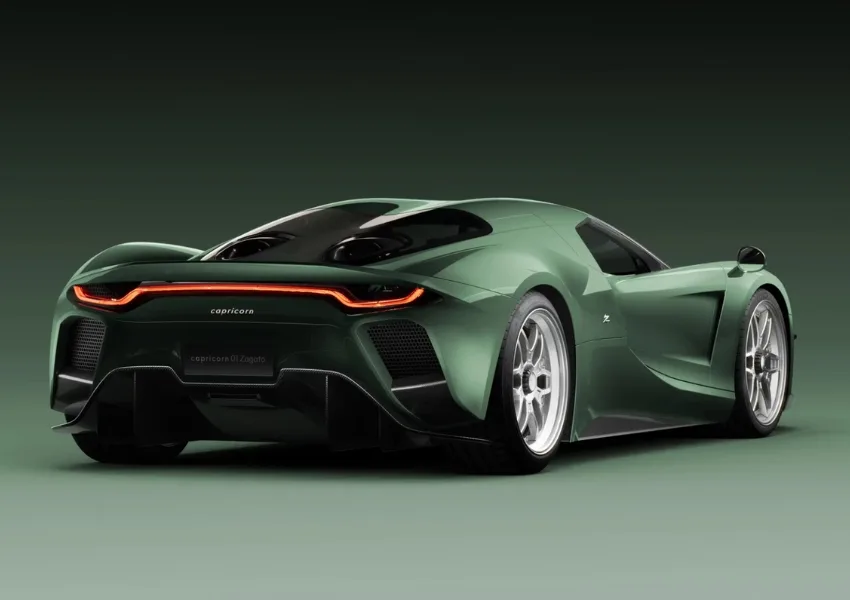

Capricorn 01 Zagato
Image Credit: Car.capricorngroup
You usually associate Zagato with famous coachbuilt classics, but the name Capricorn might be unfamiliar. Based in Düsseldorf, the German engineering firm has spent years producing lightweight structures and precision engine components for motorsport and aerospace programs. Now it enters the world of Motor Show Reveals with its own road-legal machine.
The result is the Capricorn 01 Zagato, a hypercar that mixes German engineering with Italian design. The project combines Capricorn’s racing hardware expertise with styling led by designer Norihiko Harada. Instead of following the direction of many Upcoming Models filled with electronic assistance, the car focuses on driver involvement.
A Bespoke Carbon-Fiber Structure
At its core, you get a full carbon-fiber chassis. Not just the passenger cell but also the subframes and crash structures are made from the same material. Most high-end performance cars still attach aluminum sections to a carbon tub, yet here everything is integrated for stiffness and reduced mass.
The suspension also mirrors endurance racers. A pushrod setup sits front and rear, supported by adjustable Bilstein coil-overs and anti-roll bars. Braking comes from Brembo carbon-ceramic discs with six-piston calipers, mounted behind 21-inch forged wheels engineered in-house. The structure is closer to a Le Mans prototype than to typical production vehicles seen at the Chicago Auto Show or other public launch events.
The Ford-Based V-8 That Delivers Nearly 900 HP
Behind the cabin sits a supercharged Ford-derived V-8. It begins as the 5.2-liter Predator engine but receives extensive internal changes from Capricorn. The company installs a flat-plane crankshaft, redesigned pistons and rods, a dry-sump system, and new cooling and intake systems. A bespoke ECU manages the calibration.
Output reaches at least 888 horsepower and more than 730 lb-ft of torque, revving to 9,000 rpm. With a curb weight just 2,654 pounds, the numbers create a dramatic power-to-weight ratio. You approach hypercar performance without relying on hybrid assist seen in many 2027 Concept Cars and electric-boosted flagships.
Why It Still Uses a Manual Transmission
Instead of a dual-clutch gearbox, you operate a five-speed manual transmission from Italian manufacturer CIMA. The dogleg shift pattern makes it feel like a racing car adapted for public roads. Capricorn intentionally avoided heavy electronic driver aids.
You get only ABS and traction control. The steering assistance works only at low speeds, and after that you manage the feedback yourself. The philosophy centers on driver connection rather than outright acceleration numbers. Even so, the car targets under-three-second acceleration to 60 mph and a 224-mph top speed.
Key driver-focused elements include:
- Mechanical gearshift with direct linkage
- Minimal electronic intervention
- Adjustable pedal box and steering column
- Moveable shifter position for ergonomics
This approach separates the car from modern Automotive Innovation trends that rely heavily on software management.

The Zagato hypercar
Image Credit: Car.capricorngroup
Clean Aerodynamics Instead of Large Wings
Visually the car avoids dramatic spoilers. Downforce mostly comes from the underbody floor, front and rear diffusers, and a subtle rear spoiler. The aim is stability without sudden aerodynamic changes, making the vehicle more predictable for non-professional drivers.
The exterior follows a Fresh Exterior Design language typical of Zagato. Smooth curves replace sharp edges, and the bodywork stays elegant rather than aggressive. It stands apart from Next-Gen SUVs and redesigned performance sedans dominating most launch announcements.
Interior Built Around the Driver
Inside, the cockpit remains focused and mechanical. Fixed seats integrate into the carbon safety cell, while padding adjusts to suit different drivers. The steering wheel includes only a start button and a mode selector for Comfort, Sport, and Track.
The dashboard uses analog gauges with a central tachometer. There is no audio system. Titanium and aluminum switchgear combine with Connolly leather and Alcantara surfaces, keeping materials premium but purposeful.
Limited Production and Global Availability
Production is limited to 19 cars, referencing Zagato’s founding date in 1919. Pricing begins around $3.5 million before taxes and shipping. The car is homologated in several regions including Europe, Japan, and the Middle East, with interest also coming from North America under special import rules.
Capricorn confirms this will not be its last project. A future model is already planned using the same platform but with a different silhouette.
Context Among Modern Launch Dates
While most headlines currently focus on the 2026 BMW X3 30 xDrive, the Nissan Tekton reveal, and electric models like the Jeep Recon EV or Maserati Folgore Series, the Capricorn stands apart. It does not compete with hybrid crossovers or redesigned mainstream vehicles such as the Toyota Crossover 2026 or Honda Prelude release. Instead, it represents a rare case of a purely mechanical performance car appearing in a digital era.
Conclusion
The Capricorn 01 Zagato shows that a hypercar can still prioritize mechanical connection over automation. With a lightweight chassis, nearly 900 horsepower, and a manual gearbox, you get a machine designed for engagement rather than convenience. In a period defined by electrification and software-heavy performance vehicles, this launch offers a reminder that driving involvement still has a place among modern automotive developments.